

Minor penalties last for two minutes, major penalties last for five minutes, and a double minor penalty is two consecutive penalties of two minutes duration. In the NHL if a game is decided in overtime or by a shootout the winning team is awarded two points in the standings and the losing team is awarded one point. After these six total shots, the team with the most goals is awarded the victory. International play and several North American professional leagues, including the NHL (in the regular season), now use an overtime period identical to that from 1999–2000 to 2003–04 followed by a penalty shootout. The total elapsed time from when the puck first drops, is about 2 hours and 20 minutes for a 60-minute game.
Since it is held in the spring, the tournament coincides with the annual NHL Stanley Cup playoffs and many of the top players are hence not available to participate in the tournament. International club competitions organized by the IIHF include the Continental Cup, the Victoria Cup and the European Women’s Champions Cup. The Memorial Cup, a competition for junior-level (age 20 and under) clubs is held annually from a pool of junior championship teams in Canada and the United States. One of the oldest international ice hockey competition for clubs is the Spengler Cup, held every year in Davos, Switzerland, between Christmas and New Year’s Day. Pre-season tournaments include the European Trophy, Tampere Cup and the Pajulahti Cup. There are also several annual tournaments for clubs, held outside of league play.
History
The league is the direct successor to the Russian Super League, which in turn was the successor to the Soviet League, the history of which dates back to the Soviet adoption of ice hockey in the 1940s. The Kontinental Hockey League (KHL) is the largest and most popular ice hockey league in Eurasia. The Professional Women’s Hockey League is the highest level of club competition in women’s hockey.
- The league expanded beyond the former Soviet countries beginning in the 2011–12 season, with clubs in Croatia and Slovakia.
- Another popular concept in ice hockey defensive tactics is that of playing a 200-foot game.
- It was not until after the 1990 Women’s World Championship that body checking was eliminated from women’s hockey internationally.
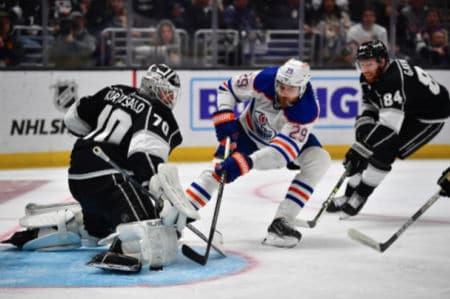
- A net defended by goaltender Braden Holtby of the Washington Capitals is targeted by a shot from forward Bryan Rust of the Pittsburgh Penguins.
Team Reset: Oilers add Andersen, hire Babcock as coach
On the other hand, ball-based variant is governed by International Inline Skater Hockey Federation. Inline hockey puck variant is played by two teams, consisting of four skaters and one goalie, on a dry rink divided into two halves by a center line, with one net at each end of the rink. There are national club championships in many countries and the top clubs in the world play in the Bandy World Cup every year. A similar Russian sport can also be seen as a predecessor and in Russia, bandy is sometimes called “Russian hockey”. Bandy is played with a ball on a football pitch-sized ice arena (bandy rink), typically outdoors, and with many rules similar to association football. Indoor hockey is played on a smaller area and between smaller teams than field hockey and the sidelines are replaced by solid barriers from which the ball rebounds and remains in play.
In most countries, the game is played between single-sex sides, although they can be mixed-sex. The game is popular among both men and women in many parts of the world, particularly in Europe, Asia, Australia, New Zealand, South Africa, and Argentina. Field hockey is played on gravel, natural grass, or sand-based or water-based artificial turf, with a small, hard ball approximately 73 millimetres (2.9 in) in diameter. Organizations dedicated to the codification of rules and regulations began to form, and national and international bodies sprang up to manage domestic and international competition.
The sports betting in Australia Svenska damhockeyligan (SDHL), known as the Swedish Women’s Hockey League in English, announced in 2022 that it would include body checking during its 2022–23 season, but would maintain a prohibition on open-ice hits. Prior to this point, body checking had been a part of the women’s game in most cases, including in Europe. A single minor penalty may be extended by two minutes for causing visible injury to the victimized player.
Up until the 1999–2000 season, regular-season NHL games were settled with a single five-minute sudden death period with five players (plus a goalie) per side, with both teams awarded one point in the standings in the event of a tie. In a formal game, each team has six skaters on the ice at a time, barring any penalties, including a goaltender. Bandy has its roots in England in the 19th century, was originally called “hockey on the ice”, and spread from England to other European countries around 1900 (the first international match took place in early 1891, when Bury Fen Bandy Club visited Haarlem). The sport is recognized by the IOC, including the variety rink bandy. By the 19th century, the various forms and divisions of historic games began to differentiate and coalesce into the individual sports defined today.
The NHL’s 84-game schedule release highlights Brady Tkachuk’s return to Ottawa on October 21.
Carolina Hurricanes owner Tom Dundon’s decision to include his family on the Stanley Cup has become a lightning rod for controversy online. The most expansive season in NHL history will begin in September, not October, and limit most teams to four preseason games.
The Galway Statute enacted in Ireland in 1527 banned certain types of ball games, including games using “hooked” (written “hockie”, similar to “hooky”) sticks. In Inner Mongolia, the Daur people have been playing beikou, a game similar to modern field hockey, for about 1,000 years. The various games are usually distinguished by proceeding the word hockey with a qualifier, as in field hockey, ice hockey, roller hockey, rink hockey, or floor hockey. Hockey includes both summer and winter variations that may be played on an outdoor field, sheet of ice, or an indoor gymnasium. Would Leo Carlsson’s addition boost the Flyers’ odds of winning their division?
The puck can only be played by the goalie in the area just behind the net and directly in front of the goal line, which is indicated by two red lines flanking the net. Playing the puck in the “corners” of the rink adjacent to their own net is now prohibited for goalies. The only exceptions to this rule involve intentionally falling on the puck, holding it with the body, carrying it in hand, or shooting it out of play in their defensive zone, each of which results in a two-minute penalty for delay of game. To make up for a previously missed scoring chance, a player who is obstructed is permitted to take a penalty shot from the center red line and try to score on the goalie without any other players on the ice. A player receives a penalty shot when another player’s illegal behavior halts a clear chance to score, most commonly during a breakaway.
In the United States especially, college hockey is popular and the best university teams compete in the annual NCAA Men’s Ice Hockey Championship. The PWHL rule-book outlines that body checking is permissible “when there is a clear intention of playing the puck or attempting to ‘gain possession’ of the puck”, which is allowed principally along the boards. The Professional Women’s Hockey League, the highest level of women’s professional hockey, which debuted in 2024, also allows body checking. The idea of reintroducing body checking to the female game after its removal in the 1980s and 1990s remains controversial. In women’s IIHF ice hockey today, body checking is considered an “illegal hit” and is punishable by a minor penalty, major penalty and game misconduct, or match penalty.

Often, when a player checks an opponent from behind into the boards, a minor or major penalty for boarding is imposed. Typically, major penalties given for fighting cancel each other out, so neither team has a player disadvantage, and players leave the penalty box after play is stopped once their penalties expire. In particularly violent cases of minor infractions causing intentional injury to an opponent or visible injury (like bleeding) resulting from a minor penalty, five-minute major penalties are enforced, including those for fighting. Instances of rule violations in the sport serve as examples; penalties may be imposed on the players who commit them. In addition to any penalties that their team must serve, players may also face personal extended penalties or expulsion from the game for misconduct.